
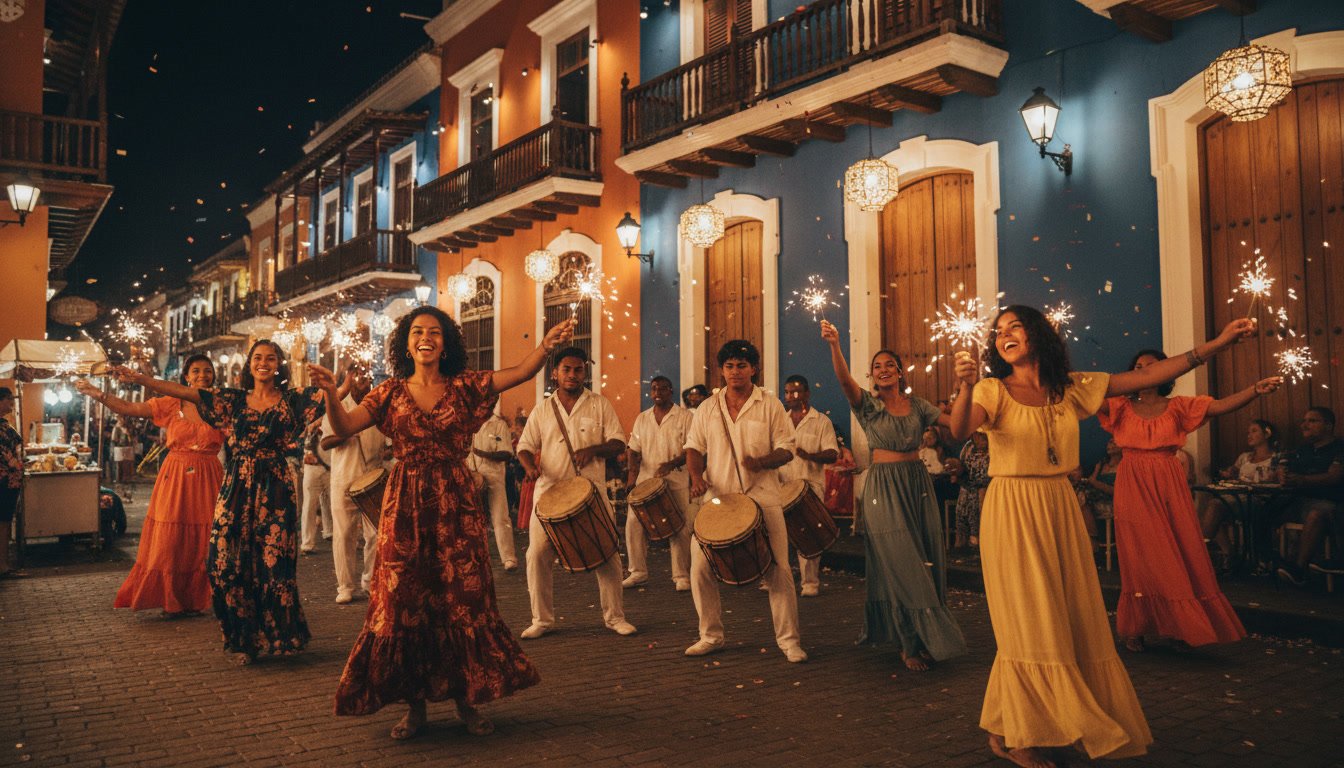

Thinking about Latin music and fashion through the lens of biopolitics means recognizing that both are territories where life expresses itself beyond the frameworks that attempt to regulate it. From rhythms born in the margins to aesthetics emerging from the streets, music and fashion operate as practices that overflow cultural control mechanisms, which means that Latin creativity is not merely an artistic phenomenon but a form of vital insistence.
As we advance in this reflection, it becomes evident that music and fashion share a genealogy of resistance. Salsa, reggaetón, and cumbia emerged in contexts where state surveillance was intense; in parallel, urban, Caribbean, and Chicano aesthetics were historically stigmatized. Yet both expressions not only survived but expanded, demonstrating that biopolitics may attempt to administer life, but it cannot suffocate its creative impulse.
In this sense, Latin music has been a space where bodies find ways to assert themselves, while fashion has functioned as a visual extension of that assertion. Thus, when a rhythm becomes a community anthem, so does a hairstyle, a color, a silhouette. Music and fashion intertwine to produce subjectivities that escape normativity, which means that both practices generate identities that do not conform to the parameters of power.
A study by Hall (1996) on cultural representation argues that marginalized groups use aesthetics and symbolic expression to dispute the meanings that power attempts to impose on them, which means that visual and sonic culture not only reflects identities but actively produces them. This idea illuminates how Latin music and fashion operate as practices of everyday resistance.
However, this resistance does not occur in a vacuum. On the contrary, it emerges in tension with structures that seek to normalize difference. The global music industry attempts to define which sounds represent “the Latin world,” while commercial fashion selects which bodies embody a marketable aesthetic. Even so, music and fashion find cracks through which to subvert these narratives, demonstrating that cultural life cannot be fully administered.
In fact, when a marginal rhythm becomes a trend or when a peripheral aesthetic becomes a global reference, it becomes clear that Latin creativity possesses a capacity for escape that destabilizes control mechanisms. Music introduces new sensibilities, while fashion reconfigures the visibility of bodies, which means that both practices produce a movement that challenges the logic of cultural homogenization.
A study by Muñoz (1999) on performativity and queer futurities argues that the aesthetic expressions of marginalized bodies function as anticipations of possible worlds, which means that performance—whether sonic or visual—allows us to imagine forms of life that do not yet fully exist. This reading is key to understanding how Latin music and fashion project alternative futures.
From this perspective, we can observe that Latin music not only narrates experiences but enables modes of existence that contradict normativity. Complementarily, fashion not only dresses bodies but legitimizes them in public space. Thus, both practices become tools to claim presence, dignity, and agency in contexts where biopolitics attempts to regulate visibility.
Moreover, in the digital era, music and fashion intersect with an algorithmic biopolitics that administers the circulation of images and sounds. Platforms decide which songs go viral and which aesthetics are deemed desirable. Yet this administration is never total: users reinterpret, remix, and transform, which means that collective creativity overflows algorithmic patterns.
For this reason, every improvised dance on TikTok, every look emerging from a peripheral neighborhood, every remix that goes viral without institutional backing constitutes a form of resistance. Music and fashion become practices that rewrite Latin identity from below, from bodies that insist on existing outside the norm. This insistence reveals that cultural life cannot be fully captured by control mechanisms.
Likewise, history shows that Latin creativity has always emerged from mixture, hybridity, and movement. Both music and fashion draw from cultural crossings, migrations, and appropriations. This hybrid condition complicates any attempt to fix a single or stable identity, which translates into a structural resistance to regulatory efforts.
Consequently, music and fashion not only resist regulation—they transform it. Every time an artist challenges dominant aesthetics or a community reinterprets a global rhythm, a reconfiguration of the cultural field occurs. These practices not only question power but generate new forms of sensitivity, new ways of inhabiting the body, and new possibilities of existence.
For this reason, Latin music cannot be understood without its aesthetic dimension, nor fashion without its sonic dimension. They feed into each other, creating a cultural ecosystem where life expresses itself in multiple layers. This interdependence reveals that resistance is not an isolated act but a continuous process manifested in everyday gestures, aesthetic decisions, and bodily movements.
Thus, when we observe the global expansion of Latin music and fashion, we should not interpret it solely as a commercial phenomenon but as an affirmation of life. Creativity emerging from the margins becomes a reminder that life insists, even when regulated. Music and fashion are, in this sense, pedagogies of resistance: they teach us how to exist with dignity in contexts of control.
Ultimately, Latin music and fashion invite us to recognize that life cannot be fully governed. In every rhythm that exceeds the norm, in every aesthetic that challenges the dominant gaze, a profound truth pulses: life vibrates. And that vibration—emotional, bodily, collective—is a form of freedom. This is why affirming that Latin creativity transforms biopolitics is not a metaphor; it is a confirmation that life, even when administered, always finds a way to express itself fully.
