
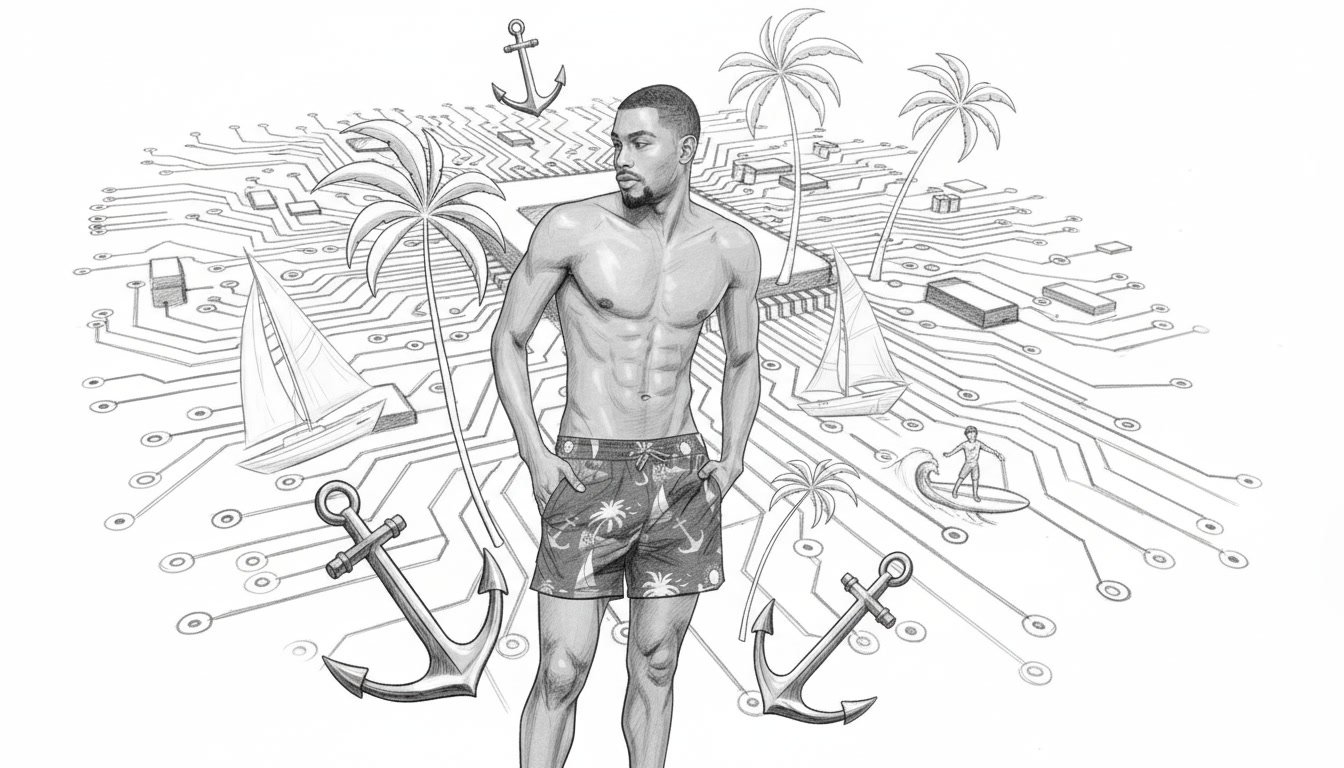

The history of digital connectivity rests upon a technical object whose presence often goes unnoticed: the motherboard. This printed circuit board, which began as a rudimentary platform for housing basic components, has become the essential infrastructure that orchestrates contemporary global communication. Its evolution has not only transformed computing but has also redefined how societies relate, access knowledge, and construct meaning in an interconnected world. At Bénieller, this technological architecture becomes a visual and conceptual language that inspired our print Pico de Loro, a simultaneous tribute to digital connectivity and to the remote geography of the Colombian Pacific.
From Board to Digital Ecosystem: A Structural Evolution
The first modern motherboard emerged in 1981 with the IBM Planar Breadboard, which integrated the CPU, RAM, and essential ports onto a single substrate. This milestone consolidated logic that had previously been distributed across multiple independent cards into one physical plane, marking the beginning of a new era of fluid and simultaneous connectivity (McHugh, 1981).
In the 1990s, Intel’s ATX standard reorganized the internal architecture of computers, integrating formerly peripheral functions—such as audio, networking, and storage—directly into the board and transforming the motherboard into a true operational center (Pctechguide, 1995).
The Motherboard as Nervous System: Connectivity and Communication
Functionally, the motherboard operates as the central nervous system of any device: it connects the CPU, memory, storage, and external components, allowing information to flow without friction. As Commodore History notes, it is “a hub that facilitates communication among all connected components” (CommodoreHistory, 2024). Without this infrastructure, modern computing—and by extension, global connectivity—would be impossible.
The evolution of standards such as PCIe has multiplied data‑transfer capacity; PCIe 6, for instance, doubles the bandwidth of its predecessor to meet the demands of AI and high‑performance systems (Nag, 2023). Contemporary connectivity is, in essence, the direct result of these innovations that allow information to travel faster, farther, and with lower latency.
The Aesthetics of Interconnection: When Technology Becomes Visual Language
Beyond its technical function, the motherboard possesses its own aesthetic: a cartography of lines, nodes, and pathways that evokes urban maps, biological systems, and neural networks. At Bénieller, this aesthetic becomes a conceptual resource. As a brand, we recognize that connectivity is now an essential component of human identity, and that technological visuality can meaningfully dialogue with cultural, geographic, and emotional narratives.
From this intersection emerges Pico de Loro, a print named after an almost secret surf spot on the Colombian Pacific, renowned for its perfect hollow waves and geographic isolation. Accessible only by boat from Nuquí, within the Gulf of Tribugá, it is a destination sought by surfers who pursue untouched nature, high‑quality swell, and an experience profoundly removed from urban life. At Bénieller, we believe that such places embody the essence of remoteness: territories where nature dictates the rhythm and where human connection depends on memory, oral tradition, and—more recently—technology.
Pico de Loro: A Visual Tribute Between Nature and Technology
At Bénieller, we conceive Pico de Loro as a bridge between two worlds: the wild geography of the Colombian Pacific and the digital architecture that sustains contemporary connectivity. For this reason, the graphics of the man surfing over a motherboard background, the palm trees, the anchors, and the marine elements are not decorative; they are a symbolic tribute to that remote and majestic place.
Pico de Loro
“just as it articulates communication among components, technology today allows places like Pico de Loro—once known only to local communities and adventurous surfers—to become visible to the world.”

Here, the motherboard functions as metaphor: just as it articulates communication among components, technology today allows places like Pico de Loro—once known only to local communities and adventurous surfers—to become visible to the world. At Bénieller, we understand that without contemporary digital infrastructure, the existence of this paradise would remain a geographic secret. Connectivity makes it possible for its history, its waves, and its biodiversity to be shared globally.
The print, therefore, does not merely depict a landscape; it represents a network. A network of maritime routes, surf trajectories, digital circuits, and human connections woven into a single visual plane.
A Symbol of an Era and an Aesthetic Inspiration
The evolution of the motherboard is not merely a technical chapter in the history of computing; it is the material foundation of the connectivity that defines our era. Its capacity to integrate, communicate, and sustain complex systems has enabled new forms of human interaction, new economies, and new aesthetic sensibilities.
At Bénieller, we interpret this architecture as a cultural symbol. Pico de Loro thus becomes an editorial statement on contemporary interconnection: a print that fuses nature and technology, territory and circuitry, swell and data. It is both a tribute to a remote place and a reflection on how digital connectivity allows us to discover it, imagine it, and celebrate it.
