

Yet recent scientific evidence reveals that leg strength, mobility, and circulation directly influence brain structure, memory, processing speed, and the ability to sustain deep attention. The legs function as a dynamic system that drives blood, oxygen, and metabolic signals toward the brain, supporting its vitality.
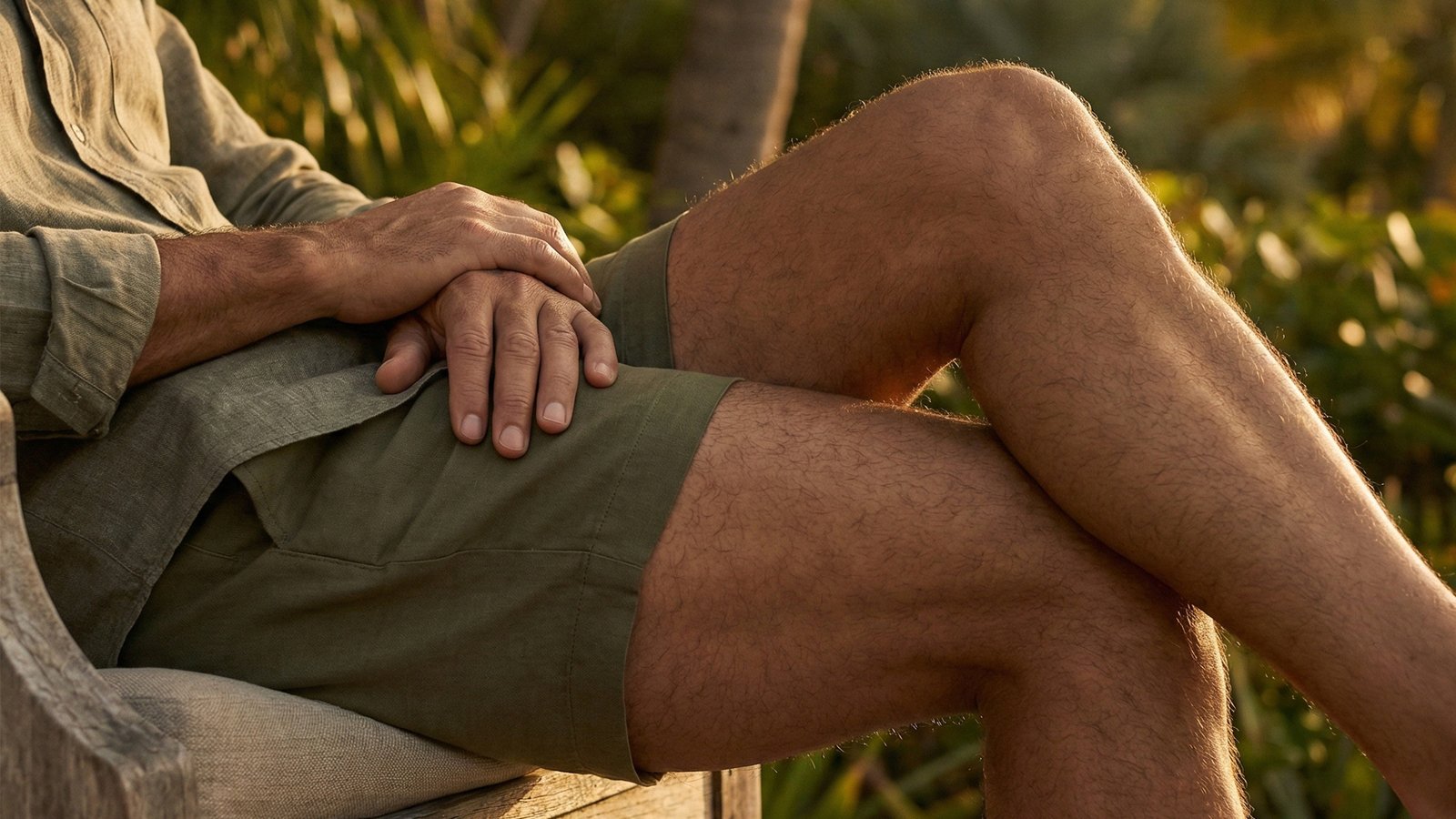
Showing healthy, well‑trained legs becomes an expression of integrated wellbeing. The choice of 4-inch shorts, with their balance of comfort and proportion, allows the musculature of the legs to be revealed with elegance and naturalness, celebrating the bodily architecture that sustains the mind.
Strong legs, resilient brain: scientific evidence
Science has begun to describe this relationship with precision. In a ten‑year longitudinal study, Steves, Spector, and Jackson (2016) demonstrated that leg strength predicts cognitive aging with remarkable clarity. The authors state: “Leg power robustly predicted cognitive change over a decade, even after adjusting for lifestyle, health status, and early-life factors” (Steves et al., 2016).This finding is reinforced by neuroimaging: “Stronger legs were associated with greater total grey matter volume and smaller lateral ventricles” (Steves et al., 2016).
Brain structure is better preserved when the legs maintain power and stability.
Other studies have observed that leg muscle activity stimulates neurotrophic factors essential for memory. Erickson et al. (2011) concluded: “Aerobic exercise increased hippocampal volume by 2%, effectively reversing age-related loss” (Erickson et al., 2011).
Leg movement supports the growth of the hippocampus, a region central to memory and learning. The literature also highlights that leg strength relates to greater capacity for sustained attention and more active social engagement—both fundamental for cognitive health. Brown (2025) synthesizes this relationship: “Maintaining leg strength supports brain health by preserving mobility, social engagement, and hippocampal integrity” (Brown, 2025).
The aesthetics of wellbeing: showing legs as an expression of cognitive health
The musculature of the legs is one of the most visible manifestations of constant movement. Walking, climbing stairs, performing squats, or cycling activates muscle groups that send metabolic signals to the brain, strengthening its adaptive capacity.
Showing trained legs communicates intention, discipline, and clarity. The 4-inch short length offers a balance between freedom of movement and aesthetic proportion, allowing the leg to express itself naturally. This length reveals the shape of the quadriceps, the stability of the vastus medialis, and the harmony of the calves—elements that reflect an active body and a present mind. The visibility of healthy legs conveys a silent message: physical vitality and cognitive vitality advance together.
Movement, circulation, and mental clarity
The legs function as a physiological pump that drives blood toward the brain. Muscle contraction supports venous return, oxygenation, and metabolic regulation. This dynamic sustains mental clarity, creativity, and the capacity for deep concentration.
As McKenna (2025) states: “The most cognitively resilient older adults are those who have stayed physically active across the lifespan” (McKenna, 2025). Cognitive resilience is built through the body, especially through the legs.
An invitation to embodied presence
Caring for the legs is caring for the brain. Strengthening them, moving them, and showing them with pride expresses an elevated understanding of wellbeing: the coherence between physical architecture and mental clarity. Well‑trained leg musculature becomes a visible sign of cognitive vitality—a silent indicator of discipline, presence, and the capacity to sustain a life in motion. Aesthetics take on an intellectual role: the body communicates what the mind cultivates.
The 4-inch short length aligns with this philosophy with precision. This proportion allows the leg to be revealed with elegance, authenticity, and a discreet sophistication that respects anatomy and celebrates its function. It is a length that supports mobility, comfort, and conscious bodily expression, inviting one to inhabit the body with intention.
Showing healthy, trained legs is a declaration of integrated wellbeing. It affirms that intelligence is also expressed in the way we move, in the way we hold the body, and in the clarity with which we advance. Physical presence becomes an extension of mental presence, and aesthetics transform into a language that communicates health, purpose, and personal excellence.
